
Sellers still cover most buyer agent fees in practice, but that's no longer automatic. Since August 2024, buyers must sign a buyer representation agreement that spells out exactly what their agent charges before they tour a single home. Commission is negotiable on both sides, varies by market, and depends entirely on what the purchase contract says.
TL;DR:
- Buyers now must sign a representation agreement detailing their agent’s fee before viewing any properties, making commission negotiations more transparent.
- Despite the rule change, most sellers still cover buyer-agent fees through concessions or build them into the offer, keeping the old system largely intact.
- Actual agent earnings are reduced by brokerage splits, often leaving agents with less than half of the total commission once expenses are deducted.
- Realtor fees are typically paid out of the seller's proceeds directly from escrow, with no separate line item in the closing statement.
- Alternative models like flat-fee listings, cash sales to investors, or limited-service agents offer options for more control over costs and process speed.
Table of Contents
- Who Pays Realtor Fees Today: Common Models
- How Realtor Commissions Are Calculated
- How Realtor Fees Get Paid at Closing
- How to Negotiate Realtor Fees
- Alternatives to Traditional Commission Models
- Tax Implications of Realtor Fees
- Conflicts of Interest in Realtor Fee Arrangements
- What We See in Practice
- Get a Cash Offer or List for 1%: Two Paths, No Commission Guesswork
- Sources
Who Pays Realtor Fees Today: Common Models
For decades, the seller paid the full commission at closing and split it between their listing agent and the buyer's agent through the local MLS. That system changed shape after the NAR settlement rules took effect in August 2024, which removed the requirement that listing agents advertise buyer-agent compensation on the MLS.
In practice, though, not much has shifted for most sellers. A year out from the rule change, commission structures look largely the same in many markets, with sellers frequently still agreeing to cover the buyer's agent fee as part of the deal. What's different is the paperwork: buyers now sign a written agreement up front that locks in their agent's fee, rather than assuming the seller will handle it.
Here's how fee responsibility tends to break down depending on the transaction:
- Traditional seller-paid model: The seller negotiates commission with their listing agent, and that fee (or a portion of it) gets offered to whoever brings a buyer, seller included.
- Buyer-paid arrangements: Some buyers, especially in competitive markets or with sellers unwilling to offer concessions, pay their agent directly, either as a flat fee or a percentage negotiated in their representation agreement.
- Split or negotiated fees: A buyer might negotiate a lower rate with their own agent, then ask the seller to cover the remainder through a credit at closing.
- Unrepresented buyers: A buyer working without an agent removes that cost entirely, though they take on more of the legwork themselves.
Seller concessions have become the workaround of choice in a lot of deals. Instead of the seller directly compensating the buyer's agent, they build a credit into the offer that the buyer can apply toward their own agent's fee or closing costs. Functionally, it lands close to the old system. Legally, it's a separate line of negotiation, and it gives sellers more control over how the money moves. Historically, sellers paid both sides of the commission by default; today it's a choice they make deal by deal, market by market.
How Realtor Commissions Are Calculated
Most agents still charge a percentage of the sale price, though flat-fee and à la carte models have gained ground since the rule changes. The percentage model remains dominant because it ties agent pay to outcome, but it's not the only structure on the table anymore.
By the Numbers: Commission rates have stayed close to historical norms even after the 2024 rule changes, with total commission averages holding in a similar range across most markets rather than dropping sharply as some predicted.
To see what that means in dollars, take a $300,000 home sale with a combined 5% commission split between listing and buyer agents:
- Total commission: $15,000
- Listing agent's side: $7,500 (2.5%)
- Buyer agent's side: $7,500 (2.5%)
- Agent's actual take-home: Often less than half of that $7,500, once the brokerage split is applied
That last point trips people up. An agent doesn't pocket their full side of the commission. Most work under a brokerage split, commonly somewhere between 50/50 and 70/30 in the agent's favor depending on experience and brokerage model. A newer agent at a traditional brokerage might keep $3,500 of that $7,500 after the split, before taxes and business expenses.
This is also where flat-fee models change the math entirely. A flat 1% listing fee on that same $300,000 home comes to $3,000, a fraction of the traditional $7,500 listing side, while still providing full MLS exposure and licensed representation. For sellers focused on net proceeds rather than tradition, that gap is worth running the numbers on before signing anything.

How Realtor Fees Get Paid at Closing
Here's something that surprises a lot of first-time sellers and buyers: commission almost never shows up as its own line item on the buyer's closing disclosure. Instead, the title or escrow company disburses the agreed fees straight out of the seller's proceeds, following whatever the purchase contract and listing agreement specify. The money moves behind the scenes, governed entirely by contract language settled weeks earlier.
That makes the agreements themselves the real document to scrutinize, not the closing paperwork. Realtor points to the same conclusion: know your numbers before you sign, because by closing day the terms are locked.
Before signing a listing agreement or a buyer representation agreement, confirm these four things:
- The exact fee, whether it's a percentage, a flat dollar amount, or a tiered structure.
- Who pays it, and under what condition that could change (for example, if the seller refuses to offer a concession).
- How long the agreement lasts, and what happens if you want to cancel or switch agents.
- What's included, so you're not surprised by add-on charges for marketing, staging consults, or administrative fees.
Pro Tip: Ask your agent to write out a "net sheet" showing what you'll actually walk away with after commission, concessions, and closing costs, before you sign anything. It takes five minutes and removes almost all the guesswork.
Buyer representation agreements are the newest piece of this puzzle, and they exist specifically to prevent the confusion that used to happen when buyers assumed their agent was "free." Rocket Mortgage's breakdown of the rule change is clear on this point: fees are contract-dependent and negotiable by law, but only if you negotiate before you sign, not after.
How to Negotiate Realtor Fees
Commission has never been fixed by law, and that's truer now than ever. Whether you're selling or buying, the leverage is in the conversation you have before any paperwork gets signed.
If you're selling, a few moves tend to work:
- Compare service levels across agents rather than just commission percentage. A lower rate paired with weak marketing can cost you more in a slower sale.
- Ask about a flat-fee or reduced-commission listing option if your home is likely to sell quickly or you're comfortable handling some tasks yourself.
- Structure your offer strategy around concessions instead of a blanket commission offer, so you control exactly where that money goes.
If you're buying, your leverage sits in the representation agreement itself:
- Ask for full fee disclosure in writing before you tour a single property.
- Negotiate the term length and cancellation terms so you're not locked into an agent who isn't performing.
- If the market allows it, ask your agent whether a seller concession toward your fee is realistic given local norms.
Before signing with any agent, ask directly: What's included in this fee? What's your marketing budget for my listing? What are the cancellation terms if this isn't working out? And can you walk me through a net-to-seller scenario at a couple of different sale prices?
Pro Tip: Vague fee language is the biggest red flag in any agreement. If an agent can't tell you exactly what you'll pay and under what conditions it changes, get it in writing before you go any further, or work with someone else.
Alternatives to Traditional Commission Models
A percentage commission isn't the only route to selling a house. Flat-fee MLS listings get your home into the same buyer pool for a fixed cost, and they make sense when your home is in solid condition and likely to move fast. Cash sales to investors trade some sale price for speed and certainty, a good fit for foreclosure timelines, probate deadlines, or homes that need work you can't do before listing. Limited-service or à la carte agent options sit in between, useful if you're comfortable handling showings yourself but still want MLS exposure and contract help.
Tax Implications of Realtor Fees
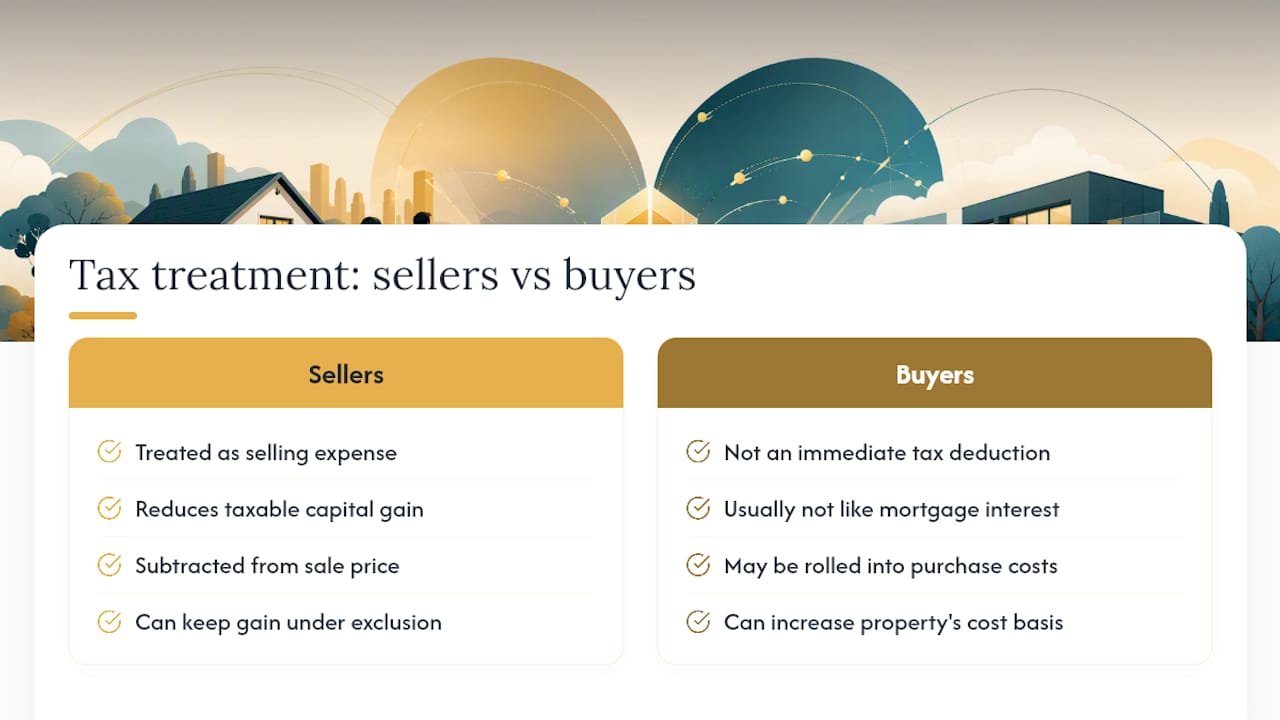
For sellers, commission is generally treated as a selling expense that reduces your taxable gain, not a separate deduction you claim elsewhere. It gets subtracted from your sale price when calculating capital gains, alongside other closing costs like transfer taxes and title fees. That distinction matters if you're close to the capital gains exclusion threshold on a primary residence, since a lower net gain can keep you under it.
For buyers, realtor fees you pay directly typically aren't tax-deductible the way mortgage interest or property taxes are. If your fee gets rolled into your overall purchase costs, it can sometimes factor into your cost basis for the property, which affects your gain calculation whenever you eventually sell. That's a benefit you won't see until years down the line, not an immediate write-off.
None of this is a substitute for advice from a tax professional who can look at your specific numbers, especially if you're navigating an inherited property, a rental conversion, or a sale that involves multiple owners. The rules shift based on how the property was used and how long you held it, and getting the classification wrong on a return is a more expensive mistake than the commission itself.
Conflicts of Interest in Realtor Fee Arrangements
Commission structures create incentives worth understanding before you sign with anyone. An agent paid a percentage of sale price benefits from a higher number, which usually aligns with your goals as a seller, but it can also create pressure to accept a faster offer over a better one if the agent is prioritizing a quick close.
Dual agency, where one agent or brokerage represents both buyer and seller, deserves extra scrutiny. The agent is supposed to stay neutral, but they're earning both sides of the commission from a single transaction, which is a real tension even when handled ethically. Many states require written disclosure and consent before dual agency can proceed, and you're allowed to say no.
Buyer representation agreements introduce a newer wrinkle: an agent locked into a fixed fee has less incentive to negotiate hard on price if a lower sale price doesn't affect their pay. Ask directly how your agent's compensation is structured and whether it changes based on the final price. A transparent answer is a good sign. Hesitation or vague language is the more common warning sign worth walking away from.
What We See in Practice
Most sellers we talk to care about three things above everything else: speed, certainty, and not sinking more money into repairs before they can list. Traditional commission conversations often skip right past those priorities and jump straight to percentage points.
That's why we built two clear paths instead of one. A flat 1% full-service listing keeps a seller in the traditional MLS process, with a licensed Realtor® handling the transaction, at a fraction of the standard commission. A quick cash offer skips the listing process entirely for sellers who need speed and certainty more than they need top dollar. Neither is objectively better. It depends on your timeline, your property's condition, and what "success" looks like for your situation. Compare both scenarios side by side using our selling options comparison before deciding.
— Justin
Get a Cash Offer or List for 1%: Two Paths, No Commission Guesswork
If you've read this far, you already know commission isn't fixed and doesn't have to eat into your equity the way it used to.

Both options work whether you're dealing with foreclosure, an inherited property, a rental with tenants still in place, or a home that just needs to sell without months of showings. There's no obligation to pick a path before you see the numbers. Request a free comparison of your cash offer versus a 1% listing at San Diego Cash For Houses and decide with real figures in front of you, not guesswork.
Sources
For readers who want to dig deeper into how commission rules have shifted and what current market data shows, these sources cover the regulatory changes and reporting referenced throughout this article:
- Where real estate commissions stand a year after new rules were introduced
- Who Pays the Real Estate Commission and Closing Costs
- Who pays REALTOR® fees? What buyers and sellers should know