
Yes, you can sell your home with a reverse mortgage. The loan gets paid off directly from your sale proceeds at closing, and any equity left over belongs to you or your heirs. This isn't a gray area. The Consumer Financial Protection Bureau confirms that a Home Equity Conversion Mortgage (HECM) is simply a lien on your property, not a barrier to selling it, and HUD's FHA insurance backs the loan so you're never on the hook for more than your home is worth.
Two things to do right now:
- Request a payoff statement from your loan servicer so you know exactly what you owe.
- Notify your servicer and escrow officer the moment you accept an offer, so they can coordinate the final payoff demand.
Table of Contents
- How Reverse Mortgage Payoff Works at Closing
- Step-by-Step: Selling a Home With a Reverse Mortgage
- Timelines and Deadlines Heirs Need to Know
- What If the Loan Balance Is More Than the Home Is Worth?
- Estimating Your Net Proceeds Before You List
- Documents to Gather Before You List or Accept an Offer
- An Editor's View: What Actually Helps Reverse Mortgage Sellers
- Communicating With Your Servicer Throughout the Sale
- Tax Considerations When Selling a Reverse Mortgaged Home
- What Selling Really Means for You and Your Heirs
- How the Due-on-Sale Clause Affects Your Timeline
- Selling to a Buyer Using a Traditional Mortgage
- Official Resources for Verifying Reverse Mortgage Rules
- The Overlooked Truth About Reverse Mortgage Sales
- A Faster Path When You Need Certainty on a Reverse Mortgage Sale
- Sources
How Reverse Mortgage Payoff Works at Closing
When you sell a house with a reverse mortgage, escrow uses your sale proceeds to pay off the loan before you see a dime. The payoff isn't just your original loan balance. It's a combination of several figures your servicer tracks daily.
Here's what typically factors into that number:
- Outstanding principal — the amount you've actually drawn from the loan.
- Accrued interest — reverse mortgages compound interest over time, so this grows every day the loan is open.
- Mortgage insurance premiums — the FHA insurance that protects both you and the lender.
- Servicing fees and advances — costs the servicer paid on your behalf for property taxes or homeowners insurance if you didn't pay them directly.
Statistic: Payoff figures shift daily because of interest accrual, which is why RefiGuide recommends ordering a date-specific payoff statement early in escrow, since servicers typically take 5 to 10 business days to produce one and it's only valid through a stated "good through" date.
One piece of good news: HECMs generally carry no prepayment penalty under HUD rules, so you can pay off the loan the moment you sell without a fee for doing it early. If you have a proprietary (non-HECM) reverse mortgage, check your note. Terms there can differ.
Step-by-Step: Selling a Home With a Reverse Mortgage
Selling property under a reverse mortgage follows a familiar home-sale process with one extra coordination step. Here's the order that actually works.
- Contact your servicer and request a payoff quote. Ask specifically for a payoff good through a projected closing date, not just today's balance.
- Choose your sale method. A traditional listing with an agent who understands reverse mortgages can maximize price but takes longer. A fast cash sale trades some top-line price for speed and certainty, which matters more than people expect when daily interest is eating into your equity.
- Open escrow and notify the servicer of your projected closing date. This lets them prepare the final demand instead of scrambling at the last minute.
- Re-request the final payoff demand closer to closing, since interest keeps accruing.
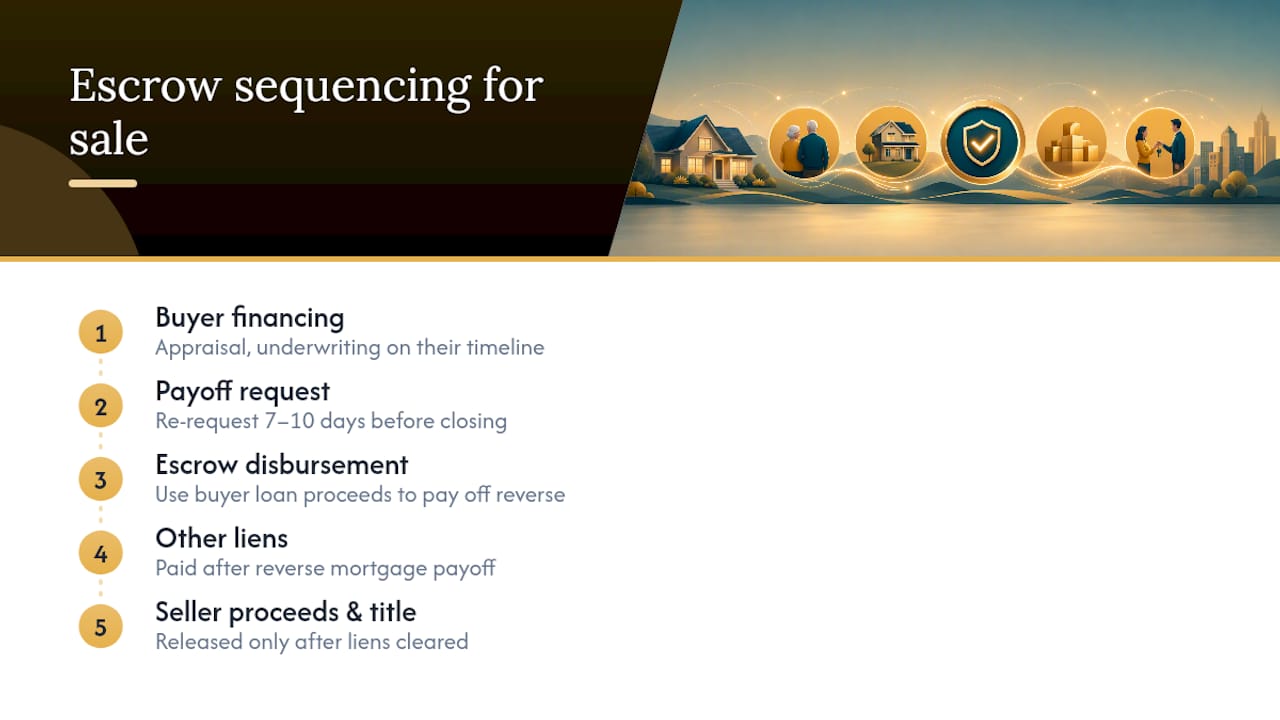
- At closing, escrow disburses funds to satisfy the reverse mortgage lien first, then any other liens, then whatever remains comes to you or the estate.
Pro Tip: Ask your escrow officer to tie the payoff demand's "good through" date directly to your projected closing date, and request a refreshed final demand about 7 to 10 days before you close. Daily interest accrual can otherwise leave you short at the table.
Reverse mortgage sale timelines usually mirror any other home sale, roughly 30 to 45 days from accepted offer to close, as long as the payoff request goes out early.
Timelines and Deadlines Heirs Need to Know
When a reverse mortgage becomes due and payable, usually after the borrower's death or a permanent move, the servicer sends a due-and-payable notice. Heirs generally have 30 days to respond to that notice.
From there, the standard window to sell or refinance is about six months, and servicers commonly grant two 90-day extensions if you're actively marketing the property and documenting it. That can stretch the process to roughly a year when needed.
Heirs facing this deadline typically have five paths:
- Sell the home and keep any leftover equity.
- Refinance into a traditional mortgage to keep the property.
- Pay off the loan balance with other funds.
- Sign a deed in lieu of foreclosure if selling isn't realistic.
- Let the lender proceed to foreclosure as a last resort.
Selling an inherited property under a tight deadline is exactly the kind of situation where a probate-friendly cash sale can beat a slow listing.
What If the Loan Balance Is More Than the Home Is Worth?
A reverse mortgage is a non-recourse loan. That single fact protects you more than most sellers realize. If your payoff exceeds what the home actually sells for, FHA mortgage insurance covers the difference, and neither you nor your heirs owe the shortfall out of pocket.
Your options when equity is thin or negative:
- Sell at appraised value. CFPB guidance confirms heirs can sometimes satisfy the loan by selling for at least 95% of appraised value, even when the balance is higher.
- Deed in lieu of foreclosure. Often faster and cheaper than a drawn-out market sale when there's no equity to protect anyway.
- An approved short sale, coordinated directly with the servicer.
Pro Tip: Get a written appraisal before you decide between listing and a deed in lieu. That number determines which option actually saves you money and time.
Estimating Your Net Proceeds Before You List
Figuring out what lands in your pocket after selling a reverse-mortgaged home comes down to simple subtraction, but the pieces add up faster than sellers expect.
- Start with your expected sale price.
- Subtract the reverse mortgage payoff (principal, interest, insurance premiums, and servicing fees).
- Subtract any other liens, like a tax lien or HOA judgment.
- Subtract closing costs, typically including agent commissions, title, and escrow fees.
Statistic: LA Metro Home Finder walks through this exact math in sample scenarios, and the pattern is consistent: the payoff amount alone often surprises sellers who haven't checked their balance in years.
If that math leaves thin equity, a faster closing timeline protects more of what's left, since every extra week on the market means more accrued interest eating into your payoff.
Documents to Gather Before You List or Accept an Offer
Reverse-mortgage closings stall for predictable reasons. Clear these hurdles before you list.
- Order your payoff statement early, since it takes days to generate and expires.
- Gather tax records, insurance documents, HOA statements, and your title report.
- Give your servicer and escrow officer your projected closing date and direct contact information.
- Resolve any property tax delinquencies or HOA arrears now, not during escrow.
Pro Tip: If you're behind on property charges, address it before listing. Unresolved delinquencies can trigger loan default proceedings that complicate or delay your sale. If foreclosure risk is already on the table, review your options for stopping the process before it escalates.
An Editor's View: What Actually Helps Reverse Mortgage Sellers
Most guidance on selling a home with a reverse mortgage treats it as a paperwork problem. It isn't. It's a timing problem. Justin here, and after digging through how servicers actually process these payoffs, the biggest risk isn't the loan structure. It's the gap between when a seller decides to sell and when they actually contact the servicer.
Here's what the two dual-option approach solves that a single-track listing doesn't:
- Fast cash offers close in as little as 7 days, which matters enormously when daily interest accrual is shrinking your equity.
- A 1% MLS listing with full Realtor® services captures more of a strong local market when equity is healthy and time isn't the constraint.
- Both paths handle homes as-is, no repairs or cleaning required, which matters for older properties that have carried a reverse mortgage for a decade or more.
- Neither option charges hidden fees, which keeps your net proceeds math clean and predictable.
If your equity position is uncertain, the smartest move is comparing what each path actually nets you before committing. Explore the full range of situations this covers, from foreclosure timelines to inherited properties.
| Point | Details |
|---|---|
| Selling is fully allowed | The reverse mortgage lien is paid from sale proceeds; leftover equity goes to the seller or estate. |
| Order payoff statements early | Servicers take 5 to 10 business days, and figures expire, so request one as soon as escrow opens. |
| Non-recourse protection matters | FHA mortgage insurance covers any shortfall if the loan balance exceeds the home's value. |
| Heirs get real deadlines, not a cliff | Six months to sell or refinance, plus two possible 90-day extensions with active marketing. |
| Speed protects thin equity | Sandiegocashforhouses offers cash closings in as little as 7 days or a 1% MLS listing, both as-is with no hidden fees. |
Communicating With Your Servicer Throughout the Sale
Silence is the single biggest mistake sellers make with a reverse mortgage. ReverseMortgageAlert notes that prompt, documented communication with the servicer, paired with evidence of active marketing, is what secures extensions and keeps foreclosure timelines from accelerating.
Start the conversation the moment you decide to sell, not after you've accepted an offer. Call your servicer, request the payoff process, and ask what documentation they need from escrow. Get the servicer's direct contact information into your escrow officer's file immediately.
As you move through the sale, update the servicer at three checkpoints: when you list the property, when you accept an offer with a projected closing date, and again about a week before closing when you request the final payoff demand. Put critical requests in writing, email plus certified mail when timelines are tight, so you have a paper trail if a deadline or extension request is ever disputed.
If you're an heir working against the due-and-payable clock, this communication matters even more. A documented history of contact and active marketing is often the difference between getting a 90-day extension and facing an accelerated foreclosure notice. Don't wait for the servicer to reach out first. Reach out, confirm receipt, and follow up in writing every time.
Tax Considerations When Selling a Reverse Mortgaged Home
Selling a home with a reverse mortgage doesn't create a special tax category of its own. The proceeds you receive from the reverse mortgage over the years were loan advances, not income, so they were never taxed and paying the loan back at sale isn't a taxable event either.
What matters for taxes is the same thing that matters in any home sale: capital gains on the property itself. If you've owned and lived in the home as your primary residence for at least two of the last five years, you likely qualify for the standard home-sale capital gains exclusion, which can shelter a significant portion of any gain from federal tax. Check with a tax professional for your specific numbers, since exclusion limits and eligibility depend on filing status and history.
For heirs, the tax picture is often more favorable. Inherited property typically receives a stepped-up basis to fair market value at the date of death, which can significantly reduce or eliminate taxable gain if the home is sold soon after inheriting it. This is one reason heirs often net more by selling promptly rather than holding the property while a reverse mortgage balance continues accruing interest.
None of this replaces advice from a CPA or tax attorney familiar with your specific situation, but understanding the basic framework helps you ask better questions before you sign anything.
What Selling Really Means for You and Your Heirs
Selling a home with a reverse mortgage shifts financial responsibility in a specific, limited way. You, or your heirs after you, are responsible for making sure the loan balance gets paid from sale proceeds at closing. That's the extent of it. Because HECMs are non-recourse loans, neither you nor your heirs personally owe anything beyond what the home sale generates.

That said, "limited liability" doesn't mean "no responsibility." If property taxes, homeowners insurance, or HOA dues fall behind before the sale closes, those obligations still need to be resolved, either by the seller before listing or out of sale proceeds at closing. Unresolved property charges are one of the more common reasons a reverse mortgage sale gets delayed or complicated.
For heirs specifically, the financial responsibility is bounded by the six-month window (plus extensions) to act. Missing that window without communicating with the servicer can shift the situation toward foreclosure, which costs heirs the chance to capture remaining equity themselves. Acting inside the window, even if it means selling quickly rather than waiting for a better market, generally preserves more value for the family than letting the deadline lapse.
The bottom line: selling transfers the loan payoff responsibility to the transaction itself, not to your personal assets or your heirs' other finances.
How the Due-on-Sale Clause Affects Your Timeline
Every reverse mortgage includes a due-on-sale clause, meaning the full loan balance becomes due the moment the home is sold or title transfers. This isn't unique to reverse mortgages. Most conventional mortgages carry the same clause. What's different is how it interacts with a loan that's been accruing interest, sometimes for years, without monthly payments.
Practically, the due-on-sale clause means your closing can't proceed until the reverse mortgage is satisfied in full. Escrow won't release title to a buyer with the lien still attached, so the payoff has to happen at the closing table, funded directly from sale proceeds. This is why getting an accurate, current payoff demand matters so much: the clause triggers automatically at sale, and there's no negotiating your way around it.
The clause also explains why servicer communication timing matters. Since the balance is due immediately at sale, not at some point after, any delay in getting your final payoff demand can hold up closing entirely. Escrow officers experienced with reverse mortgages know to request that demand early and refresh it close to the closing date specifically because of how this clause functions. Sellers who treat the payoff request as an afterthought are the ones who see closings slip by days or weeks waiting on servicer paperwork.
Selling to a Buyer Using a Traditional Mortgage
Most buyers purchasing a home that currently has a reverse mortgage will be using conventional or FHA financing themselves, and this doesn't complicate things as much as sellers fear. From the buyer's side, the transaction looks like any other home purchase. Their lender isn't assuming your reverse mortgage or taking on any relationship with your servicer at all.
The coordination happens entirely on the seller's side of escrow. Your reverse mortgage payoff gets satisfied and the lien released before or simultaneously with the buyer's new loan funding and title transferring. Escrow handles this sequencing as a matter of routine, disbursing the buyer's loan proceeds and your sale proceeds to pay off your reverse mortgage first, then any other liens, before anything comes to you.
Where timing gets tight is when the buyer's lender has a firm closing date tied to a rate lock. Their appraisal, underwriting, and loan approval run on their own timeline, separate from your payoff request. If your final payoff demand isn't ready when their financing is, you risk a delay that could jeopardize the buyer's rate lock. This is exactly why re-requesting your payoff demand 7 to 10 days before the scheduled closing matters. Sync your payoff timeline with the buyer's lender's closing date, and confirm that date with your escrow officer as soon as it's set so nobody is caught scrambling in the final week.
Selling a home with a reverse mortgage in good standing, with an accurate payoff and clear communication, works exactly like any other sale. The loan balance gets paid off first, and your remaining equity is protected by the same non-recourse rules that back the loan from day one.
Official Resources for Verifying Reverse Mortgage Rules
Before you finalize anything, confirm the details directly with these sources:
- The CFPB's reverse mortgage guide for general rules and borrower protections.
- The CFPB's Q&A on selling with a reverse mortgage for shortfall and heir-specific guidance.
- Your loan servicer directly, and the Nationwide Multistate Licensing System to confirm servicer licensing if anything feels off.
The Overlooked Truth About Reverse Mortgage Sales
Most articles on this topic treat the reverse mortgage payoff as the hard part. It isn't. The math is simple subtraction, and the CFPB's rules are clear enough that any competent escrow officer handles it routinely. The part that actually trips up sellers and heirs is decision paralysis, sitting on a due-and-payable notice or an aging market listing while interest accrues and options quietly narrow.
Conventional advice tells you to "consult a HUD counselor" and "understand your rights," which is true but incomplete. What it skips is the trade-off between speed and maximum price, and that trade-off is often more consequential than any fee or clause in the loan itself. A home sitting on the market for four extra months isn't neutral. It's four more months of accruing interest eating into whatever equity remains.
If there's one thing to prioritize, it's this: get your payoff number and your timeline clear in the first week, then decide, deliberately, whether speed or top-dollar pricing serves your situation better. Don't let the decision get made for you by a deadline you didn't track.
— Justin
A Faster Path When You Need Certainty on a Reverse Mortgage Sale
If the math in this guide left you leaning toward speed over a long market listing, that's exactly the situation Sandiegocashforhouses was built to solve. Instead of choosing between a slow traditional listing or navigating a complex payoff alone, you get two clear paths under one roof: a cash offer that can close in as little as 7 days, or a full-service MLS listing at a flat 1% commission if you'd rather test the market with Realtor® support.

Both options handle your home exactly as it sits, no repairs, no cleaning, no staging required, which matters when a reverse mortgage has been in place for years and the property needs work. There are no hidden fees on either path, so the net proceeds estimate you calculate going in is the number you can actually count on at closing. For homeowners managing property tax delinquencies, HOA arrears, or a tight heir deadline, this dual structure means you're not locked into one strategy before you know your numbers.
Start by requesting a no-obligation cash offer or a 1% listing estimate through Sandiegocashforhouses's main service page, and compare both numbers side by side before you commit to a path.
Sources
- Consumer Financial Protection Bureau — Reverse mortgages
- CFPB — What happens if I have a reverse mortgage and I want to sell my home?
- RefiGuide — Can you sell a home with a reverse mortgage?
- ReverseMortgageAlert — Payoff guidance
Recommended
- Sell a House in Foreclosure in San Diego | Stop the Auction, Keep Your Equity
- Sell a House With Code Violations in San Diego | Unpermitted Work OK
- Sell a Hoarder House in San Diego | As-Is, Full of Contents, No Cleanout
- Selling an Inherited House in San Diego: Probate, Taxes & Options | San Diego Cash For Houses